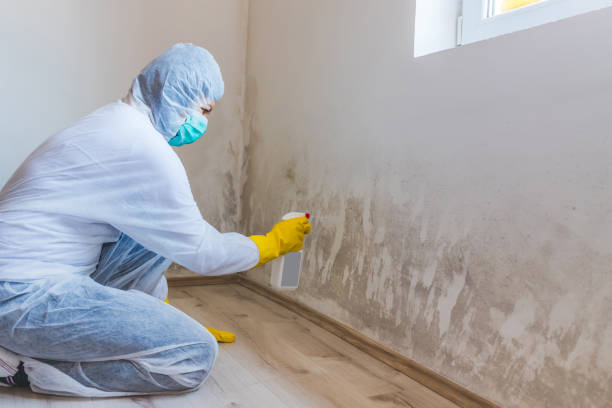
What an inspection actually is
What Happens During Mold Inspection in Butler, WI
A good inspection is an investigation of the house from top to bottom, and it should never feel like a pitch. The inspector walks the property room by room, looks at ceilings, baseboards, window sills and the backs of closets, and takes moisture readings along the way. Pin-type meters push two small probes into drywall or trim to read moisture content at that exact spot, while pinless meters sweep across a wall to find damp zones without leaving marks. Those readings get plotted on a sketch of the floor plan, which is what people in the trade call moisture mapping.
Thermal imaging won't show mold growth directly, no matter what the ads suggest. What it picks up is temperature, and since evaporating moisture cools a surface, damp spots behind paint show up as cooler patches that the inspector then confirms with a meter. A hygrometer gives relative humidity and dew point for each area. If the dew point sits close to the surface temperature of a wall, a duct or a window frame, condensation is forming there. When something looks suspicious inside a wall cavity, the inspector can usually slip a borescope through a pencil-sized hole and see the back of the drywall, the studs and the insulation without cutting anything open.
Here's what separates a useful inspection from a wasted afternoon: did anybody find the moisture source? Kill the mold without fixing the source and it grows back, often within a season. That's why the inspector checks the HVAC air handler, the evaporator coil, the condensate drip pan and drain line, the attic decking and vents, and the crawl space vapor barrier and joists, not just the room that smells. Homeowners around Butler call this line when they're buying a house, after an old leak, or when a musty odor keeps coming back and nobody can explain it.